|
Presidential elections December 2005
Results for main candidates:
|
Presidential candidate
|
Vice-presidential
candidate
|
Party or
coalition
|
Percentage
of valid vote
|
|
Evo Morales
|
Álvaro García Linera
|
MAS
|
53.7%
|
|
Jorge Quiroga
|
María René Duchén
|
Podemos
|
28.6%
|
|
Samuel Doria Medina
|
Carlos Dabdoub
|
UN
|
8%
|
|
Michiaki Nagatani
|
Guillermo Bedregal
|
MNR
|
6.5%
|
|
Felipe Quispe
|
Camila Choqueticlla
|
MIP
|
2.2%
|
The elections held on 18 December 2005 proved remarkable in many ways. Most remarkable of all was the size of Evo Morales' victory. In an eight-horse race, Morales took nearly 54% of the vote. Under Bolivia's electoral laws, if the winning presidential candidate receives less than 50% of the vote Congress selects the future president from among the two front-runners. This is the first time since Bolivia's return to democracy at the beginning of the 1980s that no such run-off vote in Congress has been required.
Opinion polls throughout the campaign had suggested Morales might win, but by no means with this sort of majority. Even a week before the elections, his supporters though he might win with 40%. But no-one predicted such a landslide. Also remarkable was the turnout. Nearly 85% of people registered to vote did so. This is a much higher rate than in any previous election, even though voting is in theory compulsory for all aged 18 and over.
Congressional elections
In the elections to Congress, the MAS landslide gave it a substantial majority in the Chamber of Deputies, albeit not the two thirds needed to change the constitution unaided.
Party representation in the legislature (both houses):
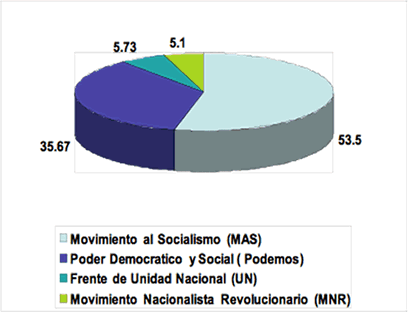
Chamber of Deputies
The MAS won 72 of the 130 seats in the Chamber of Deputies, with the opposition parties Podemos, UN and MNR sharing the remaining 58 between them.
Senate
In the Senate, Podemos took 13 seats, the MAS 12. The UN and MNR won one seat apiece. Despite lacking a majority, the MAS won the presidency of Congress due to support from UN and MNR senators.
Election of department prefects
For the first time ever, elections were also held to select the prefects who head each of Bolivia's nine departments. (Prefectures had hitherto been a presidential appointment.) This innovation has been important in the context of pressures for decentralisation in favour of the departments, and demands by some of them for greater autonomy. The MAS won the prefecture votes in three departments (Chuquisaca, Oruro and Potosí). The others were mostly won by candidates representing Podemos and/or associated with other groupings of the right. Thus Podemos candidates were elected for La Paz, Cochabamba, the Beni and Pando and an MNR candidate for Tarija. Santa Cruz was won by the head of the opposition-linked Santa Cruz Civic Committee running as an independent candidate.
Regional patterns of voting
Voting patterns in the December 2005 presidential and congressional polls reflected the country's social and ethnic make-up, with support for Morales and the MAS strongest in areas of high poverty and where a large proportion of the population of is of indigenous origin. Morales also won the overwhelming majority of votes in El Alto, the poor township attached to La Paz, and in the coca producing areas of Los Yungas and the Chapare.
In the presidential election, the MAS prevailed in the highland departments of La Paz, Cochabamba, Oruro, Potosi and Chuquisaca. Podemos came top in Santa Cruz, Tarija, Beni and Pando. Significantly, in Santa Cruz, where hostility to Morales is probably strongest, the MAS came second with nearly 33% of the vote. This shows that there is considerable support for the MAS in the eastern lowlands, probably mainly from migrants from the highlands who now form a substantial proportion of the population.
(See National Electoral Tribunal www.cne.org.bo for full breakdown and graphics.)
Reaction against the former political class
As a result of the 2005/6 elections, the three traditional parties - the ADN, MIR and MNR - have been virtually removed from the political scene. The MNR, Bolivia's strongest party since the 1940s, now holds only a handful of seats in Congress. The ADN and MIR have lost all representation in Congress, as has the newer Nueva Fuerza Republicana (NFR). The final rebuff for the MIR came when former President of the Republic Jaime Paz Zamora failed even to become prefect in his home state of Tarija.
The scale of the vote for the MAS was not just a vote for Evo Morales but a vote against a political class that was widely seen as inept and corrupt. In particular, it was a vote against a system of political parties that no longer played a role in representing people's interests. It was also a strong rejection of the liberalising economic policies pursued by successive governments in Bolivia since the mid-1980s. These failed to generate employment and broad-based development.
Presidential elections, 2009
Four years after the landslide victory in elections for president and vice-president in December 2005, with 53.7% of valid vote, in December 2009, on the basis of the new constitution, they won by a substantially larger margin (64.2%).
The results for the main candidates in 2009 were:
|
Presidential candidate
|
Vice-presidential
candidate
|
Party or
coalition
|
Percentage
of valid vote
|
|
Evo Morales
|
Álvaro García Linera
|
MAS
|
64.2%
|
|
Manfred Reyes Villa
|
Leopoldo Fernández
|
PPB-CN
|
26.5%
|
|
Samuel Doria Medina
|
Gabriel Helbing
|
UN
|
5.7%
|
|
René Joaquíno
|
Charles Suárez
|
AS
|
2.3%
|
Legislative elections, 2009
Whereas previously the MAS administration had lacked a majority in the Senate (impeding the progress of legislation), the 2009 elections gave the ruling party a majority of seats both in the Senate and the Chamber of Deputies. The breakdown of seats in the Plurinational Legislative Assembly (as the old Congress became known under the 2009 constitution) was as follows:
- The MAS won 26 seats in the Senate and 89 seats in the Chamber of Deputies
- Plan Progreso para Bolivia (PPB) won ten seats in the Senate and 36 in the Chamber
- Unidad Nacional won three seats in the Chamber only
- Alianza Social won two seats in the Chamber only.
Under the new constitution the number of seats in the Senate was increased to four per department, while the number of seats in the Chamber remained the same (130). So with a total of 166 seats in both Chambers, the MAS achieved 115, the two-thirds majority necessary (if it so desires) to reform the constitution.
The next presidential and legislative elections are scheduled for 2014.
Governorship elections, 2010
The MAS won five of the six governorships in April 2010: La Paz, Oruro, Cochabamba, Chuquisaca, Pando and Potosí, with opposition candidates successful in only three (Beni, Santa Cruz and Tarija). This compares with prefectural elections in 2005 – prefects were renamed governors in the 2009 constitution – when it won in only three (Oruro, Potosí and Chuquisaca). The governors of Beni and Tarija were subsequently replaced owing to accusations of corruption.
Municipal elections, 2010
These were held in April 2010. The results for the MAS were less favourable than in the 2009 presidential elections. Of the ten main urban centres (the nine departmental capitals plus El Alto), the MAS won in only three: Cobija (the capital of Pando), in Cochabamba and in El Alto. In 2004 elections the MAS failed to win election to any of these ten major centres. The Movimiento Sin Miedo won election in two cities (Oruro and La Paz) in 2010.
|