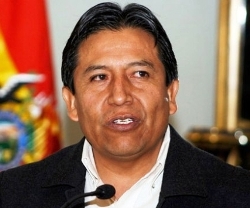
Bolivian Foreign Minister David Choquehuanca
The 2006 inauguration of Evo Morales as president greatly increased international interest in Bolivia, both in Latin America and further afield. Morales has sought to build on this to establish ties with Europe and Asia. In so doing, he is trying to reduce the country's traditional dependence on the United States. One of his first acts as president-elect was to embark on a lengthy trip abroad, on which he attracted more media attention than any previous Bolivian president. As well as Cuba and Venezuela (now close allies), he visited Madrid, Paris, Brussels, Beijing and Pretoria, before returning to Bolivia via Brasilia. Concerns were nonetheless raised as to the overall quality and consistency of the administration's early foreign policy initiatives.
Bolivia has since sought to play a significant role in international forums, pursuing its aims for greater social justice, national sovereignty and democracy in global affairs. Morales’s interventions at the United Nations General Assembly have focused on issues of human rights, indigenous rights and the threat to the planet from climate change. Bolivian leaders have played a strong role in the process of the UN Climate Change negotiations fighting for a better deal for developing countries and in 2010 Bolivia hosted the World People’s Conference on Climate Change and Mother Earth Rights which sought to galvanise global civil society to pressure for an ambitious, justice based agreement in the international negotiations.
Bolivia is a member of a number of regional blocs and organisations – as well as being a member of the Andean Community of Nations trade bloc, Bolivia is also a member of ALBA – the Alianza Bolivariana para los Pueblos de Nuestra America – along with other left-leaning governments including Venezuela, Cuba, Nicaragua, Ecuador and several Caribbean states. The ALBA bloc seeks to provide an alternative to free trade agreements and areas such as the Free Trade Area of the Americas proposed by the United States.
The organisation of South American governments, Union de Naciones Suramericanas – UNASUR, was created in 2008 as a bloc for economic and political integration bringing together two existing trade blocs (Mercosur and CAN) and all 12 South American states. It played a pivotal role in the September 2008 unrest in Bolivia when an emergency meeting was called by the pro-tempore president, Michelle Bachelet of Chile, to try to find a solution to the crisis. The organisation proved effective in helping to bring a democratic resolution to that conflict, with the South American leaders unanimously pledging their support for Evo Morales and his government. The process of integration under UNASUR continues apace, the proposed location for a South American Parliament is Cochabamba, Bolivia.
Europe
Bolivia’s colonial past and historical ties mean that relations with the continent tend to be led by the Spanish. There are also significant Spanish interests in Bolivia with investments in areas including hydrocarbons and energy, airports, finance, cinemas, and tourism. The EU is the second largest trading partner for Bolivia after the US and is a leading investor in the region, accounting for a significant share of FDI. Relations are important with Europe’s biggest economies - Germany and France are significant investors (French company Total has major investments in oil and gas), Swiss company Glencore International has interests in the mining sector and several European countries have bilateral aid programmes.
For their part, UK companies participate in Bolivia’s natural gas industry (BG Group operates several gas fields and is a partner in others), as well as in the health services sector (BUPA), energy (Rurelec) and consumer goods (Unilever). The UK’s main exports to Bolivia are beverages, industrial equipment and power generating equipment. British companies in Bolivia sell mining equipment and specialised machinery to the hydrocarbons sector, and provide a range of financial services to the banking and insurance sectors. Official figures put UK exports to Bolivia for 2010 at £15.5 million while UK imports totalled £14.6 million.
While the UK used to have a bilateral aid programme with Bolivia, this was closed in 2008. UK aid to Bolivia is now channelled through the World Bank, Inter-American Development Bank and indirectly through grants to UK NGOs. The UK also contributes to the European Union (EU) aid programme for Bolivia, currently budgeted at €243 million over 6 years. A significant part of this aid programme is directed to supporting the Bolivian government in its fight against cocaine production and trafficking.
As well as aid, relations with the EU are focused on trade and political relations, including election observation and human rights monitoring. Bolivia was engaged in the negotiation of a trade deal with the European Union as part of the Andean Community of Nations (CAN) trade bloc, however, Bolivia’s opposition to conditions of the agreement, on the grounds that it was designed to serve European rather than Bolivian interests (particularly in the area of intellectual property rights), along with objections from Ecuador, meant that negotiations with the CAN were put on hold (the EU has since concluded bilateral negotiations with Peru and Colombia, undermining the principle of negotiating bloc to bloc with developing countries).
Diplomatic relations between the EU and Bolivia were established in 1968 and the European External Action Service (EU foreign relations department) has a permanent delegation in La Paz. The EU sent electoral observation missions to several of Bolivia’s recent national electoral contests, including the recall and constitutional referendums in 2008 and 2009, and the 2009 general elections. All of these were deemed free and fair by EU observers.
The EU issued a strong statement condemning violence in the east of Bolivia and attacks against NGOs and human rights defenders during the unrest in August and September 2008. Ambassadors representing the EU ‘troika’ (the current and next EU Council presidents and the Head of the EU Delegation to Bolivia), participated in the negotiations that took place following the violence, helping opposing political forces reach a consensus on the content of the new constitution.
Within the European parliament, MEPs participate in a delegation for relations with the Andean region (DAND) made up of 24 members and substitutes from across political groups. MEPs from the DAND make visits to countries in the region twice a year. There is also a joint European/Latin American Assembly (EUROLAT) made up of parliamentarians from both continents, which sits twice a year and deals with bi-regional issues.
United States
Bolivia's relationship with the United States has historically oscillated between mutual hostility /suspicion and accommodation to Washington’s desires. In the years after the 1952 revolution, the US government regarded Bolivia as a potential communist threat in the Americas. Under the right-wing military governments of the 1960s and 1970s, that threat was assuaged. By the 1980s and 1990s, coca had replaced communism as Washington’s main concern. The bilateral relationship was at its most harmonious under the Banzer government of 1997-2001 with its 'zero-coca' policy. The US embassy in La Paz, one of its largest in the Americas, forged a close working relationship with Banzer and his successors, but was wary of the political clout of the coca farmers of the Chapare. In 2002 Manuel Rocha, then US ambassador in La Paz, warned Bolivians not to vote for Morales. His intervention simply swelled support for Morales, who only narrowly missed topping the poll.
Relations accordingly became tense with the election of Evo Morales and the MAS government in 2005. The United States sees Morales as 'soft' on coca. It also dislikes the links that he has developed between Bolivia, Cuba and Venezuela. The MAS victory reflected a resurgence in the spirit of Bolivian nationalism, which tends, today as in the past, to rail against perceived US interventionism. The administration has rejected trade liberalisation with the United States. It has also demanded the extradition of former president Gonzalo Sánchez de Lozada (who fled to the United States after his ouster in 2003), on human rights grounds. In December 2006 Morales enacted a policy placing visa requirements on US citizens entering the country, following the principle of reciprocity in diplomatic relations between the two countries.
In September 2008, following the attempts in the eastern lowlands to bring down the government and the subsequent massacre of indigenous campesinos in the northern department of Pando, Evo Morales declared Ambassador Philip Goldberg persona non grata and expelled him from Bolivia. Morales accused Goldberg of colluding with the opposition and involvement in the destabilising actions, which he referred to as a “civic coup”. The US immediately responded by asking the Bolivian Ambassador in Washington, Gustavo Guzmán, to leave the country. Bolivia then expelled the Drug Enforcement Administration (DEA) personnel from Bolivia.
The Bush administration “decertified” Bolivia in 2009 for what it said was a failure to meet its “obligations under international counter-narcotics agreements”. This was followed by the cancellation of the Andean Trade Promotion and Drug Eradication Act (ATPDEA) trade preferences for Bolivia.
Little progress has been made so far under the Obama administration. Although there were initial signs of good will from both sides - Morales expressed optimism in Obama after they met at the Summit of the Americas in Trinidad and Tobago – there has been no substantive change in relations yet. Bolivia has sought to negotiate a ‘framework agreement’ to govern bilateral relations, but this has yet to be accepted by Washington.
Chile
Bolivia's relations with Chile are strained, as they have been for much of the last 130 years, by Bolivia's loss of its maritime provinces as a result of its defeat in the War of the Pacific (1879-83). Bolivia's territorial dispute with Chile has also long been a source of nationalist fervour, not least within the armed forces, which continue to see recovery of the lost coastal territories as a patriotic duty. Full diplomatic relations between the two countries have been severed since 1978.
There have been various attempts to enter into negotiations to achieve a, 'salida al mar' for Bolivia. These efforts have however tended not to find favour in either Bolivia or Peru. (As the disputed northernmost areas of Chile actually belonged to Peru prior to 1879, a 1929 treaty gives Peru an effective right of veto over any further territorial changes). Attempts by Bolivia to court international support for its claims have been rejected by Chile, which argues that the issue is a bilateral one.
The election of the Morales government in Bolivia, as well as that of Bachelet government in Chile, in 2006, led to an improvement in relations. Ricardo Lagos, the outgoing Chilean president, attended Morales' inauguration in January 2006, becoming the first Chilean president in over 50 years to visit La Paz. A few weeks later, Morales returned the compliment by attending Michelle Bachelet's inauguration. He was met with a warm reception from Chilean leftist and trades union groups, who chanted slogans and unfurled banners in support of Bolivia's ambitions for a salida al mar. Bolivia's gas wealth and Chile's chronic energy shortage provides an incentive for both sides to work out a lasting solution. Using gas as a weapon to force Chile to give up territory was poorly received in Chile, while selling gas to Chile without some sort of territorial recompense has been a sensitive issue in Bolivia. A good deal of mutual distrust remains.
Negotiations continued after the election of Sebastián Piñera as president of Chile. His inauguration was also attended by Morales. However, Piñera made it clear during his presidential campaign that his government would not negotiate the cession of territory to Bolivia. Frustrated by this refusal, Morales announced in March 2011 his intention to seek international mediation through the International Court of justice in The Hague.
Peru
Peru and Bolivia have historically been drawn together by hostility towards Chile, since both were losers in the three-way War of the Pacific. Peru's unwillingness to concede Pacific coast access to Bolivia along Peru's southern frontier with Chile has nonetheless been an obstacle to Bolivia’s salida al mar. In 2002, Peru offered to provide an alternative route for the export of Bolivian gas, giving Bolivia port facilities in Ilo. However, a project to build a gas pipeline linking Tarija and Ilo has been shelved.
Bolivia and Peru are moreover potential rivals so far as gas sales are concerned: plans by Peru to use gas from the Camisea reserves in the Peruvian department of Cuzco to supply Chile and Argentina were seen in La Paz as an unfriendly move. Were Peru to try to build a pipeline directly to Chile across Bolivia's putative salida al mar, this would also further complicate territorial claims. The open sympathy expressed by Morales for losing candidate Ollanta Humala in the 2006 Peruvian presidential elections did little to improve relations with eventual winner Alan García.
Relations between Morales and García grew increasingly sour when Peru offered asylum to former members of Gonzalo Sanchez de Lozada’s cabinet who were due to face trial in Bolivia for their part in the military incursion into El Alto in 2003. Bolivia also criticised Peru for entering into free trade agreements with the United States and the European Union that undermined the solidarity of the Andean Community (CAN). A tit-for-tat trading of insults between Garcia and Morales ended briefly in the withdrawal of ambassadors of the neighbouring countries.
Both countries have, however, been able to find common cause in their territorial disputes with Chile (Peru has an ongoing dispute with Chile over maritime boundaries) and there was an upturn in relations towards the end of Alan García’s term when the Boliviamar agreement was re-launched, granting Bolivia enhanced access to the sea through a 99-year lease on land close to the Peruvian port of Ilo.
Brazil
Brazil has traditionally vied with Argentina for influence over Bolivian politics. It is Bolivia’s most important trading partner, both for imports and exports. It is by far the most important market for Bolivian gas. It is also the most important source of foreign investment in Bolivia, with Brazilian state-dominated hydrocarbons company Petrobras the major player in the Bolivian gas industry.
Bolivia's decision to reassert national ownership over its gas resources in May 2006 and to raise taxes payable by investors, plus the increase in the sale price of gas supplied to Brazil, put some strain on bilateral relations. Although Brazil is seeking to reduce its dependency on imported gas, Bolivia is still the main provider of gas to Sao Paulo and other states in southern Brazil. This gives Bolivia some leverage, although Bolivia needs Brazil just as much as vice-versa. Under President Lula, Morales enjoyed a close rapport with Brazil, but it is less clear whether this will remain the same under Dilma Roussef.
Argentina
Argentina has traditionally exerted considerable influence over Bolivian politics, with Argentina's own right-wing military dictatorship of 1976-1983 having been behind various coup attempts in Bolivia in the 1970s. Until Argentina discovered its own natural gas sources in the 1980s, Argentina was the only market for Bolivian gas. Argentina remains an important trading partner, and more than a million Bolivians reside, legally or otherwise, in Buenos Aires and other Argentine cities. Argentina's rapid recovery after the economic collapse of 2002 has led to renewed interest in Bolivian gas, because the country is facing a serious energy shortfall.
Agreements were signed in 2006 to build a new pipeline between the two countries to facilitate gas supplies. Argentina has agreed in principle to raise both the volumes of its purchases and the price it is prepared to pay. For Bolivia, the Argentine market provides a welcome alternative to dependence on Brazil, however these agreements have failed to materialise. Personal relations between Morales and Argentine President Nestor Kirchner were cordial. Politically, both men favoured greater state involvement in the economy and both were suspicious of Washington. This remains the case under President Cristina Fernandez de Kirchner.
Venezuela
Relations between Venezuela and Bolivia have not tended to be particularly close in the past, even though both countries were founder members of the Andean Community. Since the election of Evo Morales, however, the importance of Caracas for La Paz has grown dramatically. Morales, along with Cuba's Fidel Castro, has emerged as one of Venezuelan President Hugo Chávez's closest confidants. Venezuela is actively using its diplomatic and financial muscle to assist Bolivia and cultivate friendship there. Venezuelan aid to Bolivia has increased substantially, with Caracas offering important technical support to the renationalised Bolivian oil company, Yacimientos Petroliferos Fiscales Bolivianos (YPFB). Venezuela has also offered Bolivia military aid to bolster its defences, a controversial move which has been viewed by some as an attempt by Venezuela to stake out a military presence beyond its own borders. Chávez has made frequent visits to Bolivia since the MAS were elected, as has Morales to Caracas. However, Morales should not be regarded as a wholly uncritical ally to Chávez.
|